
Why More Mileage Isn’t Making You Stronger for Your Next Marathon

I love us runners and our race delusion.
Yes, we have amazing races where we’re flying, feeling unstoppable, and riding that high for WEEKS afterward.
And unfortunately…sometimes that makes the not-so-great races stick with us even more.
Maybe you’re heading into a Fall 2026 marathon after a race like this:
You spent 16 weeks obsessively checking every box (long runs, workouts, gels, hydration, sleep)
…only to watch runners pass you as your pace completely unraveled after mile 20.
Or maybe your lungs and running fitness actually felt fine late race…but your quads felt like concrete blocks and couldn’t hold marathon pace no matter how badly you wanted them to.
So naturally, the first thought becomes “I need to run more.”
Because maybe base building longer, increasing weekly mileage, adding another long ru, stacking more volume are the missing pieces you need.
And look: mileage IS king in marathon training.
Your aerobic engine matters. Fueling matters. Pacing matters.
Especially once you hit mile 18–20 and glycogen depletion starts becoming a major factor.
But if you felt even a little called out by the examples above…
There’s another piece of the puzzle most runners completely overlook.
And the good news?
You can train it.
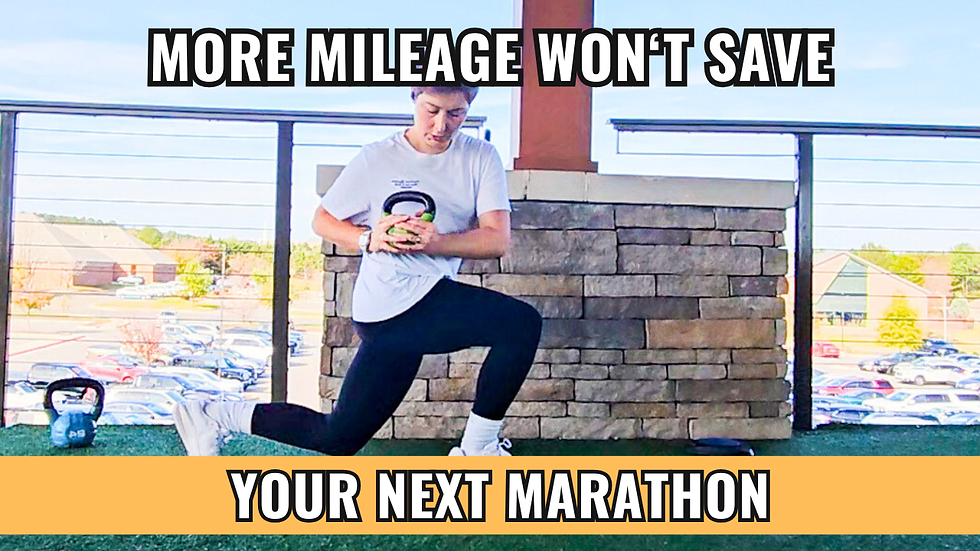
Why More Mileage Doesn’t Always Make You Feel Stronger
If you want the full exercise physiology deep-dive into WHY the final 10K gets so ugly, go check out last week’s blog post HERE.
But today, I want to focus on something different:
Why more mileage doesn’t always leave marathoners feeling stronger late race.
Now do as I say, not as I do here: I’m going to assume you already understand the massive importance of building an aerobic base.
High mileage gets all the glory because it helps build your aerobic capacity, aka your “running engine.”
That engine is carrying you through the first 18–20 miles of the marathon while:
glycogen stores slowly deplete
muscular fatigue accumulates
overall systemic fatigue increases
But one of the biggest gaps I see in marathon training as a physical therapist is this:
Runners spend SO much time training their aerobic system…and almost no time training the neuromuscular side of performance.
The Neural Effect: Why Strength Training Helps Marathoners
Long story short: Running-specific strength training can dramatically improve late-race performance when layered alongside smart marathon training.
But why?
Because of something called rate of force development.
(**record scratch** Hold on, stay with me.)
Runners are really good at describing whether a run felt “strong” or not.
But what many runners DON’T realize is that your nervous system and muscular system are inseparable.
That’s your neuromuscular system.
And it becomes incredibly important late in the marathon.
Rate of force development refers to how quickly your muscles can generate force while your foot is in contact with the ground.
Why does that matter?
Because gravity is rude and trying to keep you glued to the earth at all times.
Every stride requires force production to propel yourself forward.
Now yes, running more absolutely improves running economy and efficiency.
But research also shows that if distance runners improve their rate of force development, several beneficial adaptations occur.
When you’re running at slower efforts, you’re working at a lower percentage of your maximum force capacity.
Which means running becomes more efficient, endurance improves, and maintaining pace costs less energy.
And at marathon pace specifically, you’re able to, generate force more efficiently, reduce ground contact time, maintain pace more effectively under fatigue, and potentially reduce injury risk
In non-science words:
When your body gets better at producing force efficiently…you run stronger, longer, and with less breakdown late race.
So… How Do You Actually Train This?
This is where strength training, especially heavy resistance training and plyometrics, enters the picture.
Because yes, lifting heavy things builds stronger muscles.
But it ALSO improves communication between your nervous system and muscles.
And plyometrics become especially important because they train explosive force production and rapid muscle recruitment.
Why does this matter for marathoners?
Because by mile 20:
your muscles are fatigued
glycogen stores are depleted
your nervous system is exhausted from sending contraction signals for 2–5 hours straight
That neuromuscular fatigue is part of why the final 10K can suddenly become a complete slog-fest.
Research has shown that explosive strength training can:
improve rapid muscle activation
improve rate of force development
improve endurance performance
Translation?
Your body becomes better at continuing to produce force under fatigue.
Which is EXACTLY what marathoners need late race.
Next Steps
So now the question becomes: How do you actually DO this?
What exercises matter? How often should marathoners strength train?
What plyometrics should you start with?
How do you get stronger without completely obliterating your legs before key runs?
That’s exactly why I created PROJECT PR: my brand new FREE live workshop for marathoners.
I want to teach you how to build stronger, more fatigue-resistant legs with workouts that are:
practical
efficient
runner-specific
25–30 minutes long
doable in your living room or garage gym
Because yes, the science is super cool.
But as a busy runner, maybe you're working 1–2 jobs, maybe balancing family life too…you don’t need MORE complexity.
You need a plan that works and works for YOU.
Inside PROJECT PR, I’ll teach you the proven, science-backed method for building legs strong enough to hold up past mile 20 so you can finally PR your Fall race instead of surviving the final 10K.
I designed this specifically for novice to intermediate marathoners (2–3+ marathon cycles) who want to:
run stronger
stay injury-resistant
improve late-race performance
train smarter without turning marathon training into a second full-time job.
If you want in, tap the button below.
And until next time running fit fam…
Dare to Train Differently.
Marie Whitt, PT, DPT // @dr.whitt.fit
Running Resource book (highly recommended):
The Science of Running by Steve Magness


Comments