
Hip Pain After Running? Here’s Why It Keeps Coming Back (Even If You Stretch)

A runner was explaining to me that with "the added miles, I get bad hip pain or shooting sciatica pain sometimes".
And immediately my running-PT alarm went off.
She continued with "I've tried adding in hot yoga into my routine and it helps and so does lizard pose, and deep hip stretches feel nice when I'm able to get to them. I've done a half marathon and a 10-miler before. Right now, I'm running a 13:30 mile, running three times a week normally, and two days or other stuff like yoga or gym strength training."
But here were the key details:
"Normally, I feel it most after a higher mileage week. My right hip is normally the one that feels like a tight pinch, some shooting through my right butt cheek, but it can be on the left too. And then other times, my hips, like my butt and the sides, just feel very tight when I go to run. It's rare that it acts up while running, which is nice, but walking around at work or sitting on the couch afterwards, I feel it. "
As a physical therapist and runner, I'll be the first to admit, hip and low back symptoms can be confusing.
Vague. Overlapping.
Especially when that entire hip and near-back area just feels tight and problematic.
And when you go down the google rabbit hole for answers, you will most likely come across those infamous words.
Words like sciatica. Piriformis syndrome.
When these enter the conversation, they almost always send me off to look for a differnet culprit.
Because while it's nice to have a fancy-shamncy name for what you're experiencing, the corresponding solutions to these out-dated daignosis are not the most helpful.
Hence why this particular runner was stretching and stretching but not finding any long term relief.

What I believe was really bothering her:
a tight, cranky hip joint that was missing hip internal rotation. Because it can look an awful like this (or any combination of this):
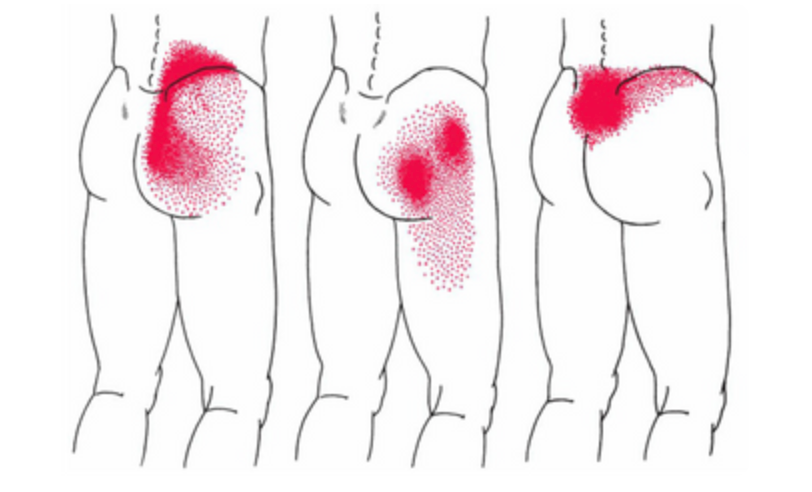
Now we can do deep into the nuance of how mileage weeks can affect hip muscles and internal rotation, resulting in not-so-happy-feeling hips. If that's something you're interested in, leave me a comment at the bottom of the blog post.
But for now, if you're here, you're probably struggling with something similar. So how about I give you a MEGA-circuit so you can get started on taking action steps to get back to running with achy hips slowing you down.
Let's hop in.
Sciatica-Like Pain in Runners: The Hidden Hip Problem You Might Be Missing
Mobility Circuit:
30 secs for 3-4 sets each // medium resistance band //
Test (optional)
Supine Hip-Fist Internal rotation Test
Half kneeling banded internal rotation mobilization
Hip that hurts: this knee is UP.
Prone Inferior glide with band
Hip that hurts: the knee towards your chest
Stability Circuit:
body weight to moderate weight
Foam roller Step Overs into IR bias
2 sets X 8 reps ea side
Internal Rotation Split Squat
2 sets X 10 reps at body weight
Forefoot Elevated split squat Isometric
3 sets X 15-30 secs hold // moderate weight ea side
Foot on wall RDL with hip IR
3 sets X 8 reps moderate weight ea side
Runner’s Hip Pain That Won’t Go Away? You’re Probably Missing This
Mobility Circuit
yes, if your hips have been a nagging pain for > 2 weeks, it is well worth your time to go get a medium-ish resistance mobility band.
THE SECRET: these are joint mobilizations that I would normally do "hands-on" in an actual PT session to help promote femoral head glide within the hip socket. So to be able to give you these tools, just in a way that looks different, is a game changer.
Because here's what you need to remember: we're going beyond stretching muscles and we're directly working on the hip joint capsule and helping restore the correct roll and glide of your actual hip joint.
Mobilizing the joint capsule can help restore more space within the actual hip joint, reduce compression on the labrum, and allow tight, deep hip muscles to function without compensation.
Stability Circuit:
This is the exciting part :D
PRO TIP: we're starting with easy looking ones on purpose. In fact, feel free to break this circuit up into 2 smaller ones.
First 2 exercises: think of these as dynamic stretches, a way to introduce this new internal rotation range that you've created with the banded mobilizations above. I'm gently guiding your body through this new mobility with exercises that gradually require more and more work from your body.
Last 2 exercises: these are pretty easy to see and how feel how these are more strength oriented rather than mobility-ish. But I love the front foot on a yoga block combined with an isometric because by elevating that front foot, you introduce hip internal rotation sooner into the split squat. This quad-focused isometric helps teach your body how to live here in this position that looks like running while emphasizing this new range.
Following that up with RDL, we continue to work into a position that resembles your running stride while now encouraged your posterior chain now to help control the new hip rotation. Plus, this RDL modified in this way really helps target and strengthen deep glute muscles
WRAPPING UP
At the end of the day, I need you to remember:
You don't need MASSIVE amounts of hip internal rotation.
(and I only say this because I've seen it dramatized on social media.)
But you do need a healthy, appropriate amount of it.
And these mobilizations, followed up these stability and strength exercises, help teach your body how to access this new range of motion rather than compensating and finding a way around it.
So next time you start to feel:
that pinchy hip after longer runs
the deep glute tightness that won’t go away
or those random “sciatica-like” symptoms that show up when you’re off your feet
You can stretch. Do yoga if you like.
But remember that relief isn’t the same as a solution.
What we walked through here gives you both pieces you’ve probably been missing:
Restoring access to hip internal rotation (mobility)
Teaching your body to use it under load (stability + strength)
This combination is what actually changes how your hip feels during high mileage training weeks and helps create long term relief.
So if your hips always feel better after stretching…but tighten right back up when mileage builds…
That’s your sign.
How often should I do these?
Because if you’re a runner dealing with this exact cycle, where something always flares up when mileage starts to add up…
That’s exactly what I help runners solve inside my Running Rescue 1-on-1 coaching.
If you want help figuring out exactly what keeps holding you back, why your hips feel unstretchable and why your glutes "wont work", let's create a rehab and strength plan together that fits your training.
Send me a message or check out Running Rescue.
Dare to Train Differently,
Marie Whitt, PT, DPT //@dr.whitt.fit


Comments